
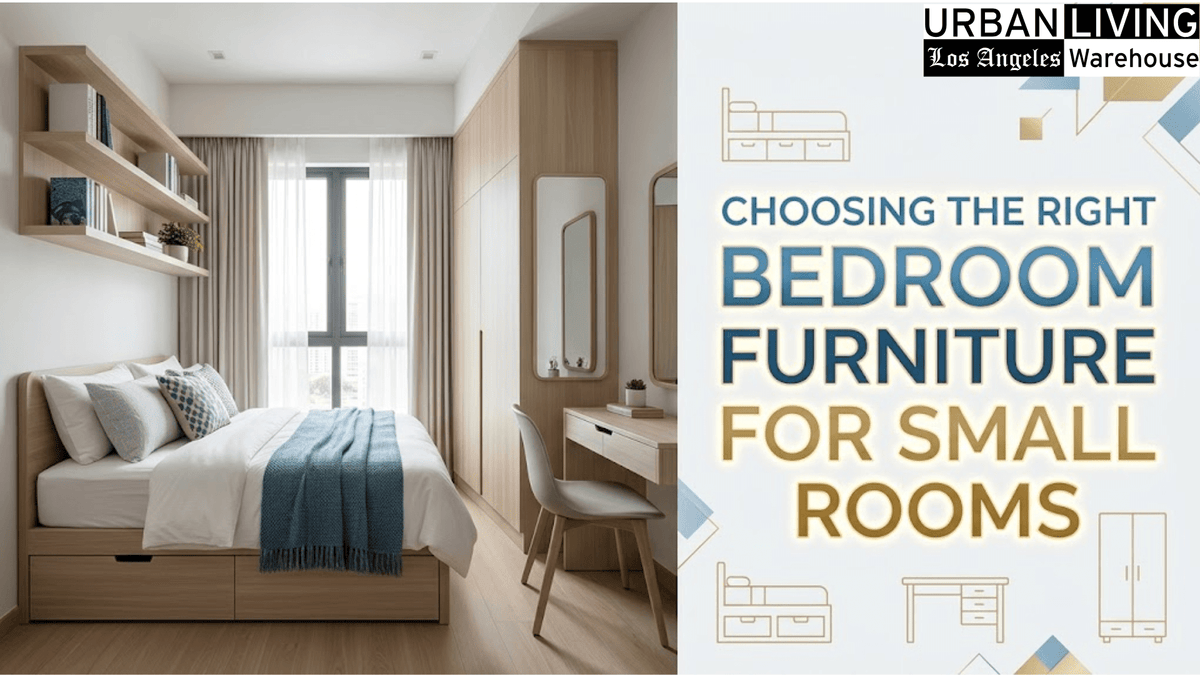
Furniture for Small Bedrooms must store more while taking up less space. A storage bed replaces a dresser. A narrow chest goes upward instead of outward. Nightstands shrink to protect the walking path. We don't choose anything purely for looks, because every piece competes for the same limited floor space.
We carry those pieces at Urban Living Furniture, from our Torrance store on Hamilton Avenue and a second location in El Monte. Our bedroom range covers beds, headboards, nightstands, chests, armoires, benches, and vanities. Measuring beats guessing carefully, and seeing the real scale in person usually settles it fastest.
What to Look for in Furniture for Small Bedrooms
Three jobs matter in a tight bedroom. The bed has to anchor the room without blocking movement around it. Storage has to hold clothing without eating a wall. Surfaces have to sit within reach of the bed. Anything failing all three is simply taking up space.
Why Bed Height Changes How a Room Feels
A high bed with a tall headboard fills the visual space immediately. Platform beds sit lower and skip the box spring entirely, which drops the whole profile several inches. That gap between the mattress and ceiling makes a small room feel open rather than stuffed.
Which Bed Styles Work Hardest in Tight Spaces
Your bed choice matters more than almost anything else in the room. Five styles below suit small bedrooms particularly well, each solving a slightly different problem rather than simply looking different from the rest.
-
Storage beds with drawers in the base
-
Platform beds needing no box spring
-
Upholstered beds with slim headboards
-
Panel beds with low profile frames
-
Daybeds for rooms doubling as offices
How Nightstand Width Affects the Walking Path
A wide nightstand pushes into the gap beside the bed, where somebody needs to walk daily. Something around sixteen to eighteen inches works far better. Nightstands with charging stations also remove cable clutter, keeping the only surface in reach genuinely usable.
How Storage Pieces Beat a Full Bedroom Set
A matching seven-piece set looks beautiful in a showroom and overwhelms a small bedroom. Buying individual pieces lets each one earn its footprint. A bed, one chest, two narrow nightstands, and a bench often store more than a full set while leaving real floor space.
Why a Chest Beats a Dresser in Narrow Rooms
Dressers spread sideways and claim an entire wall. Chests go vertical instead, holding similar capacity in roughly half the width. Door chests work even better where drawer clearance is tight. The saved wall space usually fits a chair, a lamp, or nothing at all.
Where Wardrobes Solve a Closet Problem
Older homes and apartments frequently lack proper closets. An armoire or wardrobe replaces one without building anything. Hanging space, shelving, and drawers sit inside a single footprint. Placing one against the shortest wall keeps the longer walls free for the bed and circulation.
What to Measure before Ordering
Measure the room width and depth first, then the door frame and any hallway turn. Check lift dimensions in apartment buildings. Note ceiling height for tall headboards and wardrobes. Taping the bed outline onto the floor prevents nearly every delivery day problem before it happens.
Why Shop Small Bedroom Pieces at UL Furniture
Scale is genuinely hard to judge from a photograph. Standing beside a chest answers the width question instantly. Our team can talk through measurements and what realistically fits. UL Furniture offers financing, free shipping, and a price match guarantee across both California locations.
Conclusion
Bedroom furniture for small rooms rewards pieces that store upward and sit low. A storage bed, a vertical chest, and narrow nightstands handle most of the work. Modern Bedroom Furniture follows that same logic. Our team at UL Furniture can match pieces to real measurements.
FAQ's
Does a small bedroom need a full bedroom set?
Rarely. Individual pieces usually store more and leave greater floor space, since a matching set includes items a small room cannot comfortably accommodate.
How much space do you need beside a bed?
Around two feet on at least one side. That allows you to walk past comfortably and make the bed without moving furniture every morning.